Unit Rate Calculator
This unit rate calculator divides one quantity by another to get the amount for one unit, and compares two rates side by side. 150 miles in 3 hours is 150 ÷ 3 = 50 miles per hour.
Sources: OpenStax Prealgebra 2e Updated
Compare values to find the best deal:
The unit rate formula
Unit rate = amount ÷ number of units. The result is the amount for exactly one unit: dollars per pound, miles per hour, words per minute. OpenStax Prealgebra calls a unit rate for prices a unit price.
The calculator works out rate 1 (value 1 ÷ quantity 1) and rate 2 (value 2 ÷ quantity 2) and tells you which is lower.
How to compare unit prices: two bags of rice
A 3 lb bag of rice costs $12 and a 6 lb bag costs $20. Which is cheaper per pound?
- Enter 12 and 3 for the first offer: 12 ÷ 3 = $4.00 per pound.
- Enter 20 and 6 for the second: 20 ÷ 6 = $3.33 per pound.
- Compare: $3.33 is less than $4.00, so the 6 lb bag is the better deal.
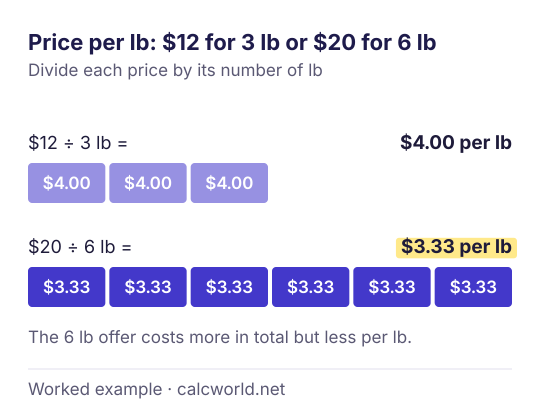
The bigger bag costs more in total but less per pound. Finding what 10 lb would cost at the same rate is a proportion, which the proportion calculator solves.
Unit rates you already use
Speed is a unit rate: miles per hour or kilometres per hour, worked out in the speed distance time calculator. Pay is another: dollars per hour, which the hourly to salary converter scales up to a year.
A price rise is often quoted per unit as well. If the price per pound goes from $4.00 to $4.20, the percent change is 0.20 ÷ 4.00 = 5%.
Use the same unit on both sides
The calculator does not know what the unit is; it only divides. Both offers must use the same unit for the comparison to mean anything: price per pound against price per kilogram would mislead.
Questions about unit rates
How do you find a unit rate?
Divide the first quantity by the second, so that the second becomes 1. $12 for 3 lb is 12 ÷ 3 = $4 per lb.
What is the difference between a rate and a unit rate?
A rate compares two quantities with different units, such as 150 miles in 3 hours. A unit rate gives the same comparison for one unit of the second quantity: 50 miles per hour.
Is the larger package always cheaper per unit?
No. It often is, but not always, which is why the unit price is worth working out. Compare the price per unit, not the total price.
Sources
- OpenStax Prealgebra 2e, 5.6 Ratios and Rate — rates, unit rates and unit prices (checked October 16, 2026)