Sum Calculator
This sum calculator adds up a list of numbers separated by commas and writes the whole addition out so you can check it. Entering 10, 20, 30, 40 gives 10 + 20 + 30 + 40 = 100.
Sources: OpenStax Prealgebra 2e Updated
Enter numbers separated by commas to calculate their sum
How to add a list of numbers
- Type the numbers with a comma between each:
10, 20, 30, 40. - Press the button. The calculator adds them from left to right.
- Read the result, written as a full addition: 10 + 20 + 30 + 40 = 100.
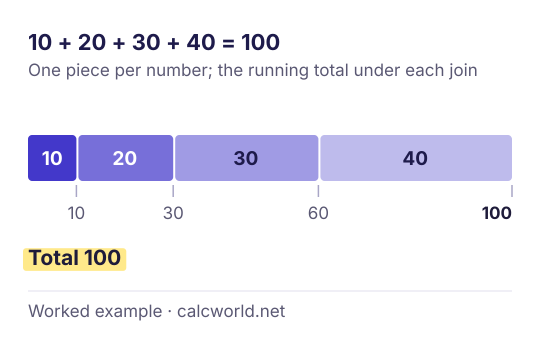
Writing the sum out shows every number that went in, so a missing or mistyped value is easy to spot. The order does not change the total, the commutative property in OpenStax Prealgebra.
Adding decimals
Entering 1.5, 2.25, 3 gives 1.5 + 2.25 + 3 = 6.75. Decimals are shown to at most two places with trailing zeros dropped, so 3.00 shows as 3.
By hand, line up the decimal points and fill the gaps with zeros: 1.50 + 2.25 + 3.00 = 6.75. To add masses in different units, convert them first, which the mass calculator does for kilograms, grams and pounds.
How invalid entries are handled
Any entry that is not a number adds nothing to the total. 10, abc, 20 gives 10 + 0 + 20 = 30, with no warning.
That keeps the calculator from stopping on a stray character, but it also means a typo is not flagged. If a total looks too low, check the written-out addition for a number that is missing or shows as 0.
Sums with a formula: sigma notation
When the numbers follow a rule, such as the squares 1, 4, 9, 16, 25, the sum can be written with Σ (a summation). The sigma notation calculator evaluates the rule for each term and adds them.
The sum is also the first step of the mean and the standard deviation, which show it in their working.
Questions about adding numbers
Does the order of the numbers matter?
No. Addition is commutative, so 10 + 40 + 20 + 30 gives the same 100 as 10 + 20 + 30 + 40.
Can I add negative numbers?
Yes. Type them with a minus sign: 10, -4, 6 gives 10 + -4 + 6 = 12. Adding a negative number is the same as subtracting its size.
How do I find the average of the list?
Divide the sum by how many numbers there are. For 10, 20, 30, 40 the sum is 100 and there are 4 numbers, so the mean is 25.
Sources
- OpenStax Prealgebra 2e, 1.2 Add Whole Numbers — addition, sums and the commutative property (checked October 16, 2026)
- Wikipedia: Summation — the sum of a sequence of numbers and its notation (checked October 16, 2026)