Expanded Form Calculator
The expanded form calculator writes a number as the sum of what each digit is worth: 4,305 = 4,000 + 300 + 5. Decimals work too, so 4790.6 = 4000 + 700 + 90 + 6/10, and the number is also spelled out in words.
Sources: OpenStax Prealgebra 2e, Wikipedia Updated
Convert numbers to expanded form and see them written in words. Try examples like 2345 or 67.89
Expanded form examples
- 2345 = 2000 + 300 + 40 + 5
- 67.89 = 60 + 7 + 8/10 + 9/100
- 5020.03 = 5000 + 20 + 3/100
What expanded form means
Expanded form writes a number as the sum of what each digit is worth in its position, its place value. A 4 in the thousands column is worth 4,000, but the same digit in the ones column is worth 4.
This is how place value is first taught, for example in OpenStax Prealgebra, and it is a quick way to check that you read a long number correctly.
How to write a number in expanded form
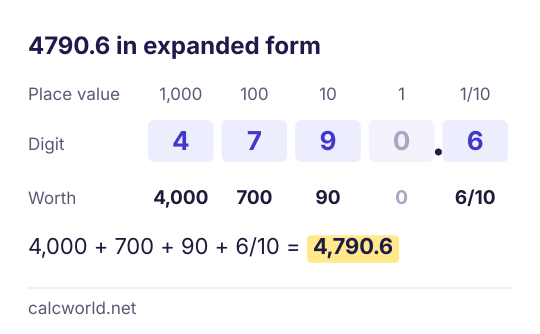
Take 4790.6.
- Name the place of each digit: 4 thousands, 7 hundreds, 9 tens, 0 ones and 6 tenths.
- Write each digit times its place: 4,000, 700, 90, 0 and 6/10.
- Drop the zero terms and join the rest with plus signs: 4790.6 = 4000 + 700 + 90 + 6/10.
The same table works in any base. In binary the places are 1, 2, 4, 8, and the binary to decimal converter adds them up the same way.
Expanded form with decimals
Each digit after the decimal point gets a denominator that is a power of ten matching its place: tenths over 10, hundredths over 100 and so on. So 67.89 expands to 60 + 7 + 8/10 + 9/100.
A fraction such as 6/10 can be simplified to 3/5; the decimal to fraction calculator does that for a whole decimal at once.
Zeros and negative numbers
A zero digit adds nothing, so it is left out of the sum instead of shown as "0 +". That is why 4790.6 has only three whole-number terms.
For a negative number, the calculator expands the positive version and puts a minus sign in front of the bracket: −305 becomes −(300 + 5).
Expanded form, word form and powers of ten
Under the sum the tool also writes the number in English words, up to just under one million; larger inputs return "Number too large". If the expanded form and the word form disagree, one of the place values was misread.
Written with powers of ten, 4,000 is 4 × 10³, which leads straight to the scientific notation converter. More place-value tools are on the arithmetic calculators page.
Expanded Form Calculator: FAQ
What is 3,056 in expanded form?
3,000 + 50 + 6. The 0 in the hundreds place adds nothing, so it is left out.
How do you write decimals in expanded form?
Each digit after the point goes over a power of ten: tenths over 10, hundredths over 100. 67.89 = 60 + 7 + 8/10 + 9/100, which some books write as 60 + 7 + 0.8 + 0.09.
What is the difference between expanded form and standard form?
Standard form is the usual way of writing the number, 4,305. Expanded form shows the sum behind it, 4,000 + 300 + 5, and word form spells it out: four thousand three hundred five.
Sources
- OpenStax Prealgebra 2e, 1.1 Introduction to Whole Numbers — place value and writing whole numbers in words (checked October 16, 2026)
- Wikipedia: Positional notation — each digit's value set by its position (checked October 16, 2026)