Factor Calculator
The factor calculator lists every whole number that divides a number exactly, with the factor pairs and the prime factorization. 36 has nine factors: 1, 2, 3, 4, 6, 9, 12, 18 and 36.
Sources: OpenStax Prealgebra 2e, Wikipedia Updated
Enter a number to find all its factors and prime factorization:
How the factor calculator finds factors
A factor of a number is a whole number that divides it with no remainder. The tool tests every whole number from 1 up to the number and keeps those that leave a remainder of zero, the same test the modulus calculator runs one number at a time.
For the factor pairs it only needs to go up to the square root, because every factor above the square root pairs with one below it.
How to find all the factors of a number
- Find the square root of the number: √36 = 6, so test 1 to 6.
- Divide by each one and keep the whole-number results as pairs: 1 × 36, 2 × 18, 3 × 12, 4 × 9 and 6 × 6. 5 does not divide 36.
- List both numbers of every pair in order: 1, 2, 3, 4, 6, 9, 12, 18, 36.
For a number that is not a perfect square, the square root calculator tells you where to stop.
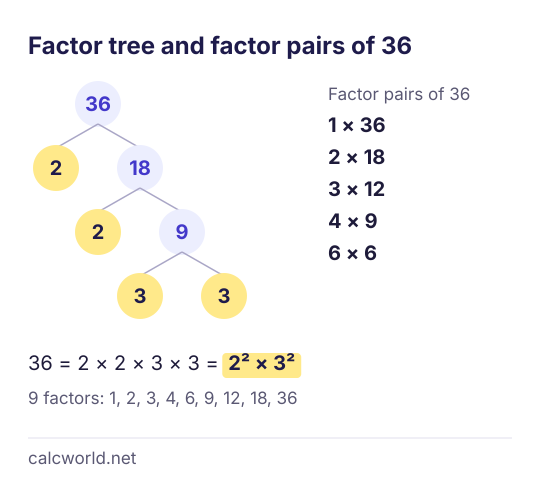
Prime factorization of 36
Divide by the smallest prime that fits until you reach 1: 36 ÷ 2 = 18, 18 ÷ 2 = 9, 9 ÷ 3 = 3 and 3 ÷ 3 = 1. So 36 = 2 × 2 × 3 × 3 = 2² × 3², the factor tree method in OpenStax Prealgebra.
Prime factors are also the quickest way to the greatest common factor of two numbers; the GCF calculator finds it for a whole list.
Prime or composite
A number is prime when it has exactly two factors, 1 and itself. 37 shows "All Factors: 1, 37" and is labelled prime. 36 has more than two factors, so it is composite.
Factors of common numbers
| Number | Factors | How many | Prime factors |
|---|---|---|---|
| 12 | 1, 2, 3, 4, 6, 12 | 6 | 2² × 3 |
| 24 | 1, 2, 3, 4, 6, 8, 12, 24 | 8 | 2³ × 3 |
| 36 | 1, 2, 3, 4, 6, 9, 12, 18, 36 | 9 | 2² × 3² |
| 48 | 1, 2, 3, 4, 6, 8, 12, 16, 24, 48 | 10 | 2⁴ × 3 |
| 60 | 1, 2, 3, 4, 5, 6, 10, 12, 15, 20, 30, 60 | 12 | 2² × 3 × 5 |
| 100 | 1, 2, 4, 5, 10, 20, 25, 50, 100 | 9 | 2² × 5² |
Input limits
Only positive whole numbers are accepted, and the box starts at 12. Because the search checks every number up to n, numbers in the millions take noticeably longer in the browser. More number tools are on the arithmetic calculators page.
Factor Calculator: FAQ
What is the difference between a factor and a multiple?
A factor divides the number exactly; a multiple is the number times a whole number. 4 is a factor of 36, and 72 is a multiple of 36.
Is 1 a prime number?
No. A prime has exactly two factors, 1 and itself, and 1 has only one factor.
Why do square numbers have an odd number of factors?
Factors come in pairs, except the square root, which pairs with itself. 36 has the pairs 1 × 36, 2 × 18, 3 × 12 and 4 × 9 plus 6 × 6, so it has 9 factors.
Sources
- OpenStax Prealgebra 2e, 2.5 Prime Factorization and the Least Common Multiple — prime factorization with a factor tree (checked October 16, 2026)
- Wikipedia: Divisor — factors (divisors) and the number of divisors (checked October 16, 2026)