Percent Error Calculator
This percent error calculator measures how far a measured value is from the accepted value, as a percentage of the accepted value. A balance that reads 492 g for a 500 g reference mass has a percent error of 1.6%.
Sources: Wikipedia: Relative change Updated
Percent error
2.1407%
The measured value is 2.1407% too low.
- Error (measured − accepted)
- −0.21
Show steps Here’s how we got it
Subtract the accepted value from the measured value
9.6 − 9.81 = −0.21
Negative: the measurement is too low.
Take the absolute value
|−0.21| = 0.21
Percent error is reported as a positive number.
Divide by the accepted value
0.21 ÷ 9.81 ≈ 0.021407
Multiply by 100 to get a percent
0.021407 × 100 ≈ 2.1407%
The percent error formula
The top of the fraction is the size of the error. Dividing by the accepted value turns it into a fraction of the correct answer, and multiplying by 100 turns that into a percent. This is the form given in Wikipedia's relative change article.
How to calculate percent error: a balance reading
You put a 500 g reference mass on a balance and it reads 492 g. What is the percent error of the balance?
Subtract the accepted value from the measured value
492 − 500 = −8
Negative: the measurement is too low.
Take the absolute value
|−8| = 8
Percent error is reported as a positive number.
Divide by the accepted value
8 ÷ 500 = 0.016
Multiply by 100 to get a percent
0.016 × 100 = 1.6%
Answer: 1.6% The measured value is 1.6% too low.
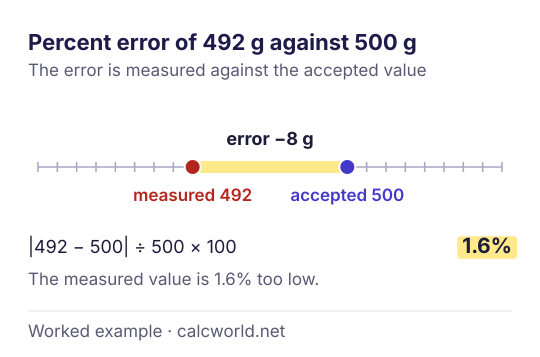
Without the absolute value the result would be −1.6%, and the minus sign says the reading is too low. Turning 0.016 into 1.6% is the step the percent to decimal calculator does in reverse.
Percent error, percent difference or percent change
Percent error needs a value you trust. With two measurements and no trusted value, use the percent difference; for a value that changed over time, use percent change.
If you repeat a measurement several times, percent error tells you how far the average is from the accepted value. How much the readings scatter around their own average is the standard deviation.
Percent error practice question
A bench is known to be exactly 2.00 m long. You measure it with a tape as 2.03 m. What is the percent error of your measurement?
Check your answer
Answer: 1.5% The measured value is 1.5% too high.
Subtract the accepted value from the measured value
2.03 − 2 = 0.03
Positive: the measurement is too high.
Take the absolute value
|0.03| = 0.03
Percent error is reported as a positive number.
Divide by the accepted value
0.03 ÷ 2 = 0.015
Multiply by 100 to get a percent
0.015 × 100 = 1.5%
Questions about percent error
How do you calculate percent error?
Subtract the accepted value from the measured value, drop the sign, divide by the accepted value and multiply by 100. A measurement of 9.6 against an accepted 9.81 gives |9.6 − 9.81| ÷ 9.81 × 100, which is about 2.14%.
Can percent error be negative?
With the usual formula, no: the absolute value makes it positive. Some courses leave the absolute value out so the sign shows the direction, negative when the measurement is too low and positive when it is too high. This calculator reports the positive percent error and tells you the direction separately.
What is the difference between percent error and percent difference?
Percent error compares a measurement with a value you trust as correct, and divides by that correct value. Percent difference compares two values when neither is known to be correct, and divides by their average.
What counts as the accepted value?
The value you are comparing against: a constant from a data table, a value given in the lab instructions, or a theoretical result worked out from a formula. It always goes in the denominator.
What is a good percent error?
There is no single cut-off. It depends on the equipment and the experiment, and your teacher or lab manual sets the standard. A smaller percent error means the measurement is closer to the accepted value.
Sources
- Wikipedia: Relative change — percent error as |experimental − theoretical| ÷ |theoretical| × 100, and the signed version (checked October 12, 2026)