Percent Difference Calculator
This percent difference calculator divides the gap between two values by their average and multiplies by 100. Prices of $72 and $88 differ by 20%, whichever one you enter first.
Sources: Wikipedia: Relative change Updated
Percent difference between 40 and 50
22.2222%
- Absolute difference
- 10
- Average
- 45
Show steps Here’s how we got it
Find the absolute difference
|40 − 50| = 10
Absolute value drops the sign, so the order of the two values does not matter.
Find the average of the two values
(40 + 50) ÷ 2 = 45
Divide the difference by the average
10 ÷ 45 ≈ 0.222222
Multiply by 100 to get a percent
0.222222 × 100 ≈ 22.2222%
The percent difference formula
The top is the size of the gap between the two values, an absolute value, so it is never negative. The bottom is their average. Both stay the same whichever value you call a, so the result does not depend on the order.
This is the relative difference measured against the mean, one of the forms listed in Wikipedia's relative change article.
How to calculate percent difference: two prices
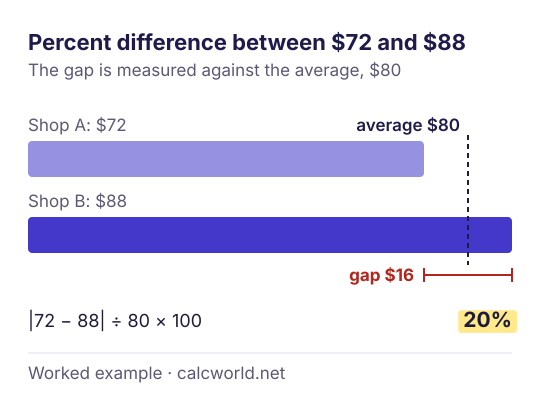
Two shops sell the same headphones for $72 and $88. What is the percent difference between the prices?
Find the absolute difference
|72 − 88| = 16
Absolute value drops the sign, so the order of the two values does not matter.
Find the average of the two values
(72 + 88) ÷ 2 = 80
Divide the difference by the average
16 ÷ 80 = 0.2
Multiply by 100 to get a percent
0.2 × 100 = 20%
Answer: 20%
When to use percent difference
Use percent difference when neither value is the reference: two measurements of the same thing, two prices, the heights of two people.
If one value is the earlier or original one, use percent change: from $72 to $88 is a 22.22% increase, and from $88 to $72 an 18.18% decrease. If one value is the known correct answer, use percent error.
Percent difference practice question
Two students time the same pendulum swing at 18 seconds and 22 seconds. What is the percent difference between their results?
Check your answer
Answer: 20%
Find the absolute difference
|18 − 22| = 4
Absolute value drops the sign, so the order of the two values does not matter.
Find the average of the two values
(18 + 22) ÷ 2 = 20
Divide the difference by the average
4 ÷ 20 = 0.2
Multiply by 100 to get a percent
0.2 × 100 = 20%
Questions about percent difference
How do you calculate percent difference?
Subtract one value from the other and drop the sign, find the average of the two values, divide the first result by the second and multiply by 100. For 40 and 50: the difference is 10, the average is 45, and 10 ÷ 45 × 100 is about 22.22%.
What is the difference between percent difference and percent change?
Percent change has a direction: it compares a new value with the old value it replaced. Percent difference has no direction: it compares two values of equal standing against their average.
From 40 to 50 the percent change is 25%, from 50 to 40 it is −20%, and the percent difference between 40 and 50 is 22.22% either way.
Does it matter which value I enter first?
No. The formula uses the absolute difference and the average, and both stay the same when the two values swap places.
Can percent difference be more than 100%?
Yes. It can go up to 200%, which happens when one of the two values is zero. For 10 and 50 the difference is 40 and the average is 30, giving about 133.33%.
How does this calculator treat negative numbers?
It divides by the average of the absolute values, (|a| + |b|) ÷ 2. For two positive numbers this is the ordinary average. Some textbooks divide by the plain average (a + b) ÷ 2 instead, which gives a different result when the signs differ, so check which form your course uses.
Sources
- Wikipedia: Relative change — relative difference using the arithmetic mean of the absolute values, with the difference of 0 and 0 defined as 0 (checked October 12, 2026)