Long Division Calculator
This long division calculator divides one number by another the way you would on paper, one digit at a time, and shows the written layout. For example, 457 ÷ 3 = 152 remainder 1.
Sources: OpenStax Prealgebra 2e Updated
457 ÷ 3
152 R 1
Quotient 152, remainder 1.
- As a mixed number
- 152 1/3
- As a decimal
- 152.3
Show steps Here’s how we got it
Start with the first digit: 4
4 ÷ 3 = 1 (because 1 × 3 = 3)
4 − 3 = 1
Bring down the 5 to make 15
15 ÷ 3 = 5 (because 5 × 3 = 15)
15 − 15 = 0
Bring down the 7 to make 7
7 ÷ 3 = 2 (because 2 × 3 = 6)
7 − 6 = 1
Read the answer off the top
457 ÷ 3 = 152 remainder 1
    152
  ┌────
3 │ 457
   −3
   ──
    15
   −15
   ───
      7
     −6
     ──
      1
Check: 152 × 3 + 1 = 457.
How to do long division: divide, multiply, subtract, bring down
Long division breaks one hard division into a string of easy ones. Each round has the same four moves, as taught in OpenStax Prealgebra:
- Divide the current number by the divisor and write the digit above the line.
- Multiply that digit by the divisor.
- Subtract the product from the current number.
- Bring down the next digit of the dividend and start again.
When there are no digits left to bring down, the number at the bottom is the remainder. It is always smaller than the divisor. The remainder on its own is what the modulus calculator returns.
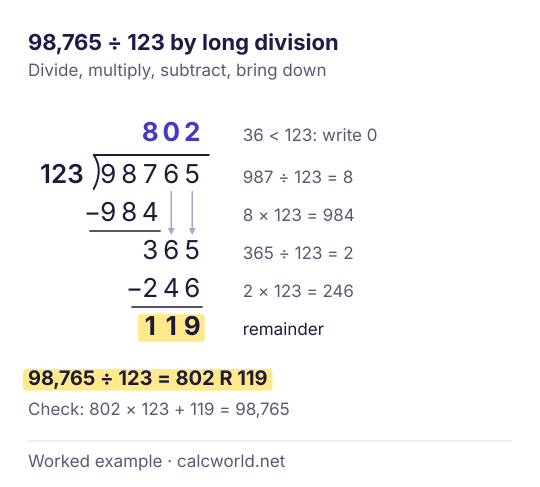
Long division example: 98,765 ÷ 123
The divisor has three digits, so the first step uses the first three digits of the dividend.
123 does not go into 98, so start with 987
987 ÷ 123 = 8 (because 8 × 123 = 984)
987 − 984 = 3
Bring down the 6 to make 36
123 does not go into 36, so write 0 in the answer.
Bring down the 5 to make 365
365 ÷ 123 = 2 (because 2 × 123 = 246)
365 − 246 = 119
Read the answer off the top
98765 ÷ 123 = 802 remainder 119
        802
    ┌──────
123 │ 98765
     −984
     ────
        365
       −246
       ────
        119
Check: 802 × 123 + 119 = 98765.
Answer: 802 R 119 Quotient 802, remainder 119.
The remainder as a fraction or a decimal
Put the remainder over the divisor for a mixed number: 802 remainder 119 is 802 119/123. That fraction is already in lowest terms, because 119 and 123 share no factor; the GCF calculator checks this for any pair.
For a decimal, carry on dividing with zeros after the point. 98,765 ÷ 123 = 802.9674796747…, and the digits 96747 repeat for ever. The fraction to decimal calculator finds the repeating block for any fraction.
Long division practice question
Work out 845 ÷ 7 by long division. What is the remainder?
Check your answer
Answer: 120 R 5 Quotient 120, remainder 5.
Start with the first digit: 8
8 ÷ 7 = 1 (because 1 × 7 = 7)
8 − 7 = 1
Bring down the 4 to make 14
14 ÷ 7 = 2 (because 2 × 7 = 14)
14 − 14 = 0
Bring down the 5 to make 5
7 does not go into 5, so write 0 in the answer.
Read the answer off the top
845 ÷ 7 = 120 remainder 5
    120
  ┌────
7 │ 845
   −7
   ──
    14
   −14
   ───
      5
Check: 120 × 7 + 5 = 845.
Questions about long division
How do you do long division?
Work from the left of the dividend. Divide the first part by the divisor and write the result on top, multiply it back, subtract, then bring down the next digit and repeat.
For 457 ÷ 3: 4 ÷ 3 is 1 remainder 1, bring down the 5 to make 15, and 15 ÷ 3 is 5. Bring down the 7, and 7 ÷ 3 is 2 remainder 1. The answer is 152 remainder 1.
What are the dividend, divisor, quotient and remainder?
The dividend is the number being divided and the divisor is the number you divide by. The quotient is the whole-number result, and the remainder is what is left over. In 457 ÷ 3 = 152 remainder 1, they are 457, 3, 152 and 1.
How do you check a long division answer?
Multiply the quotient by the divisor and add the remainder. You should get the dividend back: 152 × 3 + 1 = 457.
How do you write the remainder as a fraction or a decimal?
Put the remainder over the divisor to get a fraction: 152 remainder 1 is 152 1/3. For a decimal, keep dividing by bringing down zeros after the decimal point: 152.333…
How do you do long division with decimals?
Move the decimal point the same number of places in both numbers until both are whole numbers, then divide as usual. 12.5 ÷ 0.4 becomes 125 ÷ 4 = 31 remainder 1, which is 31.25 as a decimal. The answer is the same because both numbers were multiplied by 10.
Sources
- OpenStax Prealgebra 2e, 1.5 Divide Whole Numbers — the long division steps (divide, multiply, subtract, bring down) and checking by multiplying (checked October 12, 2026)