Decimal to Fraction Calculator
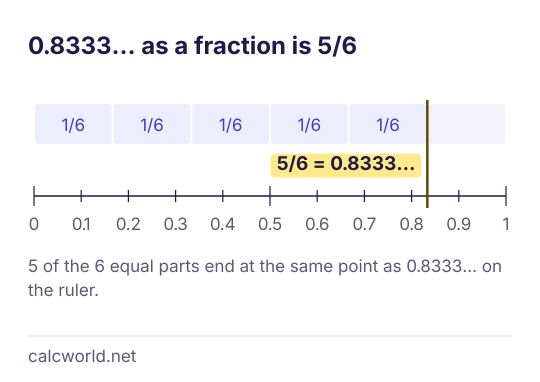
The decimal to fraction calculator writes the digits over a power of ten and simplifies: 0.75 = 75/100 = 3/4. Repeating decimals work too, so 0.8333… becomes 5/6.
Sources: OpenStax Prealgebra 2e Updated
0.75 as a fraction
3/4
- Check
- 3 ÷ 4 = 0.75
Show steps Here’s how we got it
Count the digits after the decimal point
0.75 has 2 decimal places.
Write the digits over 1 followed by 2 zeros
0.75 = 75/100
The last digit sits in the hundredths place, so the denominator is 100.
Simplify
GCD(75, 100) = 25
75/100 = 75 ÷ 25/100 ÷ 25 = 3/4
Divide the top and the bottom by their greatest common divisor.
How decimal to fraction conversion works
For a decimal that ends, each decimal place is one more power of ten in the denominator, the method in OpenStax Prealgebra:
Then divide the top and the bottom by their greatest common divisor to reach lowest terms. The GCF calculator finds that divisor: for 75/100 it is 25, which gives 3/4.
For a repeating decimal with k digits that do not repeat followed by r digits that do, multiply by 10k+r and by 10k and subtract. The repeating tails are identical, so they cancel and leave a whole number on the right:
How to convert a repeating decimal to a fraction
Write the repeating decimal 0.8333… as a fraction.
Call the number x
x = 0.8333…
The digit 3 repeats forever.
Multiply so one full repeat moves in front of the decimal point
100x = 83.33…
Multiply so only the repeating part is left behind the decimal point
10x = 8.33…
Subtract so the repeating part cancels
100x − 10x = 83 − 8
90x = 75
Both numbers have the same digits after the decimal point, so they cancel.
Divide both sides by 90
x = 75/90
Simplify
GCD(75, 90) = 15
75/90 = 75 ÷ 15/90 ÷ 15 = 5/6
Divide the top and the bottom by their greatest common divisor.
Answer: 5/6
To go the other way, the fraction to decimal calculator turns 5/6 back into 0.8333… by long division.
Decimal to fraction chart
| Decimal | Fraction | Decimal | Fraction |
|---|---|---|---|
| 0.1 | 1/10 | 0.5 | 1/2 |
| 0.125 | 1/8 | 0.6 | 3/5 |
| 0.2 | 1/5 | 0.625 | 5/8 |
| 0.25 | 1/4 | 0.666… | 2/3 |
| 0.333… | 1/3 | 0.75 | 3/4 |
| 0.375 | 3/8 | 0.8 | 4/5 |
| 0.4 | 2/5 | 0.875 | 7/8 |
For percentages, the percent to fraction calculator does the same with a denominator of 100, and the fraction calculator adds or divides the fractions you get. More tools are on the arithmetic calculators page.
Decimal to fraction practice question
Write 1.25 as a fraction in lowest terms, and as a mixed number.
Check your answer
Answer: 5/4
Count the digits after the decimal point
1.25 has 2 decimal places.
Write the digits over 1 followed by 2 zeros
1.25 = 125/100
The last digit sits in the hundredths place, so the denominator is 100.
Simplify
GCD(125, 100) = 25
125/100 = 125 ÷ 25/100 ÷ 25 = 5/4
Divide the top and the bottom by their greatest common divisor.
Write it as a mixed number
5 ÷ 4 = 1 remainder 1
5/4 = 1 1/4
Decimal to Fraction Calculator: FAQ
How do you convert a decimal to a fraction?
Count the digits after the decimal point. Write the number without the point over 1 followed by that many zeros, then simplify. 0.375 has three decimal places, so it is 375/1000, which simplifies to 3/8.
How do you convert a repeating decimal to a fraction?
Call the decimal x. Multiply by a power of ten that moves one full repeat in front of the decimal point, subtract the original so the repeating part cancels, and solve for x. For 0.333…, 10x = 3.333…, so 10x − x = 3, 9x = 3 and x = 1/3.
How do I enter a repeating decimal here?
Type the part that does not repeat in the Decimal box and the digits that repeat in the second box. For 0.8333…, enter 0.8 and 3. For 0.142857142857…, enter 0. and 142857. On a keyboard you can also type 0.8(3) in the first box.
What is 0.75 as a fraction?
3/4. Written over 100 it is 75/100, and dividing the top and bottom by 25 gives 3/4.
Can every decimal be written as a fraction?
Every decimal that ends or repeats can. Decimals that go on forever without repeating, such as π or √2, are irrational and have no exact fraction.
Sources
- OpenStax Prealgebra 2e, 5.3 Decimals and Fractions — converting between decimals and fractions; repeating decimals written with a bar (checked October 12, 2026)