Exponent Calculator
The exponent calculator raises a base to any power and names the rule it used. An exponent says how many times to multiply the base by itself: 2⁵ = 2 × 2 × 2 × 2 × 2 = 32.
Sources: OpenStax Algebra and Trigonometry 2e Updated
25
32
Show steps Here’s how we got it
Write the power as repeated multiplication
25 = 2 × 2 × 2 × 2 × 2
2 × 2 = 4
4 × 2 = 8
8 × 2 = 16
16 × 2 = 32
The exponent 5 tells you how many times 2 appears.
Exponent rules: zero, negative and fractional powers
These are the rules in OpenStax Algebra and Trigonometry, section 1.2.
For a fractional exponent, fill in both exponent boxes: the top of the fraction in the first and the bottom in the second. An exponent of 1/2 is a square root, which the square root calculator also handles with its own steps.
An even root of a negative number is not a real number, so the calculator says so instead of giving an answer.
How to work out a fractional exponent: 8 to the power 2/3
Work out 8 to the power 2/3.
Read the fraction: the bottom is the root, the top is the power
82/3 = (∛8)2
An exponent of 1/3 means the cube root.
Take the root
∛8 = 2
Check: 23 = 8.
Write the power as repeated multiplication
22 = 2 × 2 = 4
The exponent 2 tells you how many times 2 appears.
Answer: 4
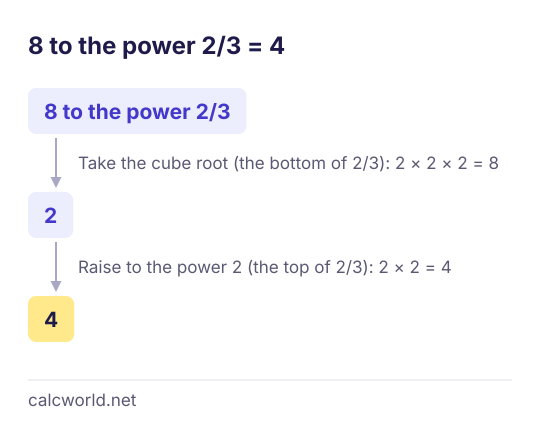
Table of powers of 2, 3 and 10
Powers of 10 are the basis of the scientific notation converter, and powers of a fixed ratio make up a geometric sequence.
| n | 2ⁿ | 3ⁿ | 10ⁿ |
|---|---|---|---|
| 0 | 1 | 1 | 1 |
| 1 | 2 | 3 | 10 |
| 2 | 4 | 9 | 100 |
| 3 | 8 | 27 | 1000 |
| 4 | 16 | 81 | 10000 |
| 5 | 32 | 243 | 100000 |
| 6 | 64 | 729 | 1000000 |
| 8 | 256 | 6561 | 100000000 |
| 10 | 1024 | 59049 | 10000000000 |
Exponent practice question
Work out 5⁻². Give the answer as a fraction and as a decimal.
Check your answer
Answer: 0.04
A negative exponent means “one over”
5−2 = 1/52
Move the power to the bottom of a fraction and make the exponent positive.
Write the power as repeated multiplication
52 = 5 × 5 = 25
The exponent 2 tells you how many times 5 appears.
Divide 1 by the result
1/25 = 0.04
Exponent Calculator: FAQ
How do you calculate an exponent?
Multiply the base by itself as many times as the exponent says. 3⁴ = 3 × 3 × 3 × 3 = 81. The exponent counts how many copies of the base are multiplied, not how many multiplication signs there are.
What does a negative exponent mean?
It means one over the base raised to the positive exponent. 2⁻³ = 1 ÷ 2³ = 1/8 = 0.125. A negative exponent does not make the answer negative.
Why is any number to the power of 0 equal to 1?
Each time the exponent goes down by 1, you divide by the base: 2³ = 8, 2² = 4, 2¹ = 2. One more step gives 2⁰ = 2 ÷ 2 = 1. The same pattern works for every base except 0.
What does a fractional exponent mean?
The bottom of the fraction is a root and the top is a power. 8 to the power 2/3 is the cube root of 8, squared: the cube root is 2, and 2² = 4. An exponent of 1/2 is a square root.
Is (−3)² the same as −3²?
No. (−3)² means −3 times −3, which is 9. Without brackets, −3² means the negative of 3², which is −9. This calculator treats a negative base as if it were in brackets.
What is 0 to the power of 0?
This calculator gives 1, the usual convention in algebra and combinatorics. In calculus, 0⁰ is called an indeterminate form because limits of that shape can come out to different values.
Sources
- OpenStax Algebra and Trigonometry 2e, 1.2 Exponents and Scientific Notation — the zero exponent rule and the negative exponent rule (checked October 12, 2026)