Polygon Area Calculator
This polygon area calculator finds the area of any polygon from the coordinates of its corners, using the shoelace formula. The triangle with corners (0, 0), (4, 0) and (0, 3) has an area of 6.
Sources: Wikipedia: Shoelace formula Updated
Enter the coordinates of each vertex of your polygon. Points will be connected in order, and the last point will connect back to the first.
Visual Representation
Grid: Each square = 1 unit
How the Shoelace Formula Works
The Shoelace formula (also known as the surveyor's formula) calculates the area of a polygon by:
- Multiplying each x-coordinate by the next point's y-coordinate
- Subtracting the product of each y-coordinate with the next point's x-coordinate
- Taking half of the absolute value of the sum
Formula: Area = ½|Σ(xiyi+1 - xi+1yi)|
The shoelace formula
For corners (x₁, y₁), (x₂, y₂), … (xₙ, yₙ) listed in order around the edge:
Area = ½ × |(x₁y₂ − x₂y₁) + (x₂y₃ − x₃y₂) + … + (xₙy₁ − x₁yₙ)|
The last term joins the last corner back to the first. The name comes from the criss-cross pattern of the multiplications, as the shoelace formula article shows.
How to find the area of a polygon from coordinates
Replace the default rectangle with three corners, (0, 0), (4, 0) and (0, 3), a right triangle with legs 4 and 3.
- Edge 1 to 2, from (0, 0) to (4, 0): 0 × 0 − 4 × 0 = 0.
- Edge 2 to 3, from (4, 0) to (0, 3): 4 × 3 − 0 × 0 = 12.
- Edge 3 to 1, from (0, 3) back to (0, 0): 0 × 0 − 0 × 3 = 0.
- Add the terms: 0 + 12 + 0 = 12.
- Take the absolute value and halve it: 12 ÷ 2 = 6 square units.
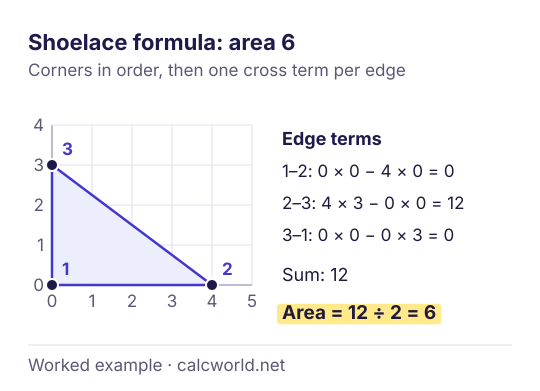
The usual triangle formula agrees: ½ × 4 × 3 = 6, as the triangle area calculator shows with base and height.
Why the default rectangle gives 12
The calculator starts with (0, 0), (4, 0), (4, 3) and (0, 3). The four edge terms are 0, 12, 12 and 0, which add to 24, and half of 24 is 12. That matches width × height = 4 × 3 = 12.
Point order and crossing edges
Enter the corners in order around the edge, clockwise or anticlockwise. Going clockwise makes the sum negative, and the absolute value turns it back into the area.
If the order jumps across the shape, the edges cross and the result is no longer the area of a simple polygon. The calculator needs at least 3 points, and every field must hold a number.
Regular polygons and side lengths
For a regular polygon, with all sides and angles equal, the polygon calculator needs only the number of sides and the side length. To get the length of one edge from its two corners, use the distance between two points calculator.
Questions about polygon area
What is the shoelace formula?
A way to find the area of a polygon from its corner coordinates. List the corners in order, multiply across in a criss-cross pattern like laces on a shoe, add the cross terms, take the absolute value and halve it.
Does the order of the points matter?
The points must go around the edge in order, either clockwise or anticlockwise. Going the other way round only flips the sign of the sum, which the absolute value removes. Jumping across the shape makes the edges cross and gives a wrong area.
Can it find the area of an irregular polygon?
Yes. The sides and angles can be anything, as long as the edges do not cross each other. For a regular polygon, where you know the number of sides and the side length, the polygon calculator is quicker.
Sources
- Wikipedia: Shoelace formula — the area of a simple polygon from its vertices, and why the order of the vertices matters (checked October 16, 2026)