Mortgage Repayment Calculator
This mortgage repayment calculator works out the monthly payment on a fixed-rate loan from the amount, the yearly interest rate and the term. $200,000 at 6% over 15 years costs $1,687.71 a month in principal and interest.
Sources: Wikipedia: Mortgage calculator Updated
Payment Summary
Principal & Interest: $1,610.46
Property Tax: $0.00
Insurance: $0.00
HOA Fees: $0.00
Total Monthly Payment: $1,610.46
Total of All Payments: $579,767.35
Total Interest Paid: $279,767.35
Amortization Schedule
| Period | Payment | Principal | Interest | Extra Payment | Balance |
|---|
The mortgage payment formula
P is the amount borrowed, r is the monthly interest rate (the yearly rate ÷ 12) and n is the number of monthly payments (years × 12). This is the standard fixed-rate formula described in Wikipedia's mortgage calculator article.
It is the same annuity sum that the future value annuity calculator uses, run in reverse: a series of equal payments that brings a balance to zero.
How to calculate a mortgage payment: $200,000 at 6% for 15 years
- Monthly rate: r = 0.06 ÷ 12 = 0.005.
- Number of payments: n = 15 × 12 = 180.
- Growth factor: (1.005)^180 = 2.4541, a power the exponent calculator can check.
- Payment: M = 200,000 × (0.005 × 2.4541) ÷ (2.4541 − 1) = $1,687.71 a month.
- Totals: 180 payments add up to $303,788.46, of which $103,788.46 is interest.
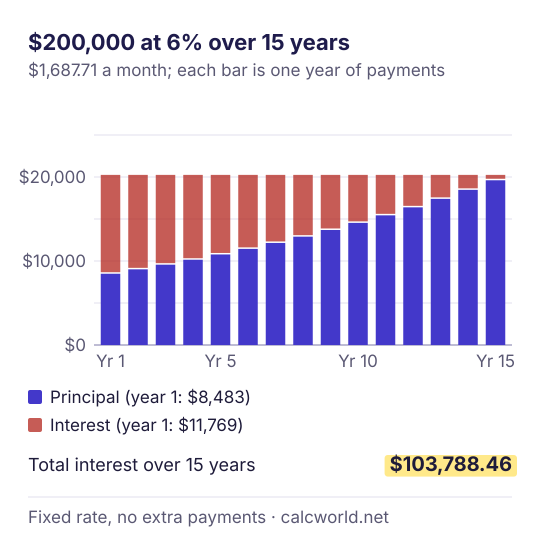
The calculator adds up the unrounded monthly payments, which is why the total is a few cents away from 180 × $1,687.71.
Where each payment goes
Each month, interest is the monthly rate times the balance still owed, and the rest of the payment reduces the balance. In month 1 that is $1,000.00 of interest and $687.71 of principal.
Over year 1 the split is $11,769 interest to $8,483 principal. By year 15 it is $643 interest to $19,609 principal. The amortization table in the calculator shows the same split month by month or year by year.
What extra payments do
An extra payment goes straight to the balance, so every later month is charged less interest. Running the calculator's schedule for this loan with $100 extra each month, the loan is paid off after 165 payments instead of 180, and the interest falls by $10,028.47.
With $200 extra the schedule ends after 152 payments and saves $18,230.42 of interest. These figures assume the lender applies the extra amount to principal in the same month.
What the calculator leaves out
It assumes one fixed rate for the whole term and the same extra payment every month. It does not model rate resets, mortgage insurance or one-off lump sums.
Property tax, insurance and HOA fees are added on top as flat monthly amounts. They change the monthly total but not the interest. To see how the home's value might change over the same years, use the home appreciation calculator; the other money tools are listed on the financial calculators page.
Mortgage Repayment Calculator: FAQ
How is a monthly mortgage payment calculated?
With M = P × r(1 + r)^n ÷ ((1 + r)^n − 1), where P is the loan, r the monthly rate (the yearly rate ÷ 12) and n the number of monthly payments. For $200,000 at 6% over 15 years, r = 0.005, n = 180 and M = $1,687.71.
Why is most of an early payment interest?
Interest is charged on the balance still owed, which is largest at the start. In the first month of the example, 0.5% of $200,000 is $1,000 of interest, so only $687.71 of the payment reduces the loan.
Does the payment include property tax and insurance?
The principal and interest figure does not. The calculator adds yearly property tax and insurance divided by 12, and any monthly HOA fee, to show a total monthly cost.
Sources
- Wikipedia: Mortgage calculator — the fixed-rate monthly payment formula and how an amortization schedule splits each payment (checked October 16, 2026)